


Stem Cells for Facial Rejuvenation
Over time, facial skin loses collagen, hyaluronic acid and elastin, and its ability to regenerate on its own also declines. Autologous stem cells are one of the options used today to stimulate that regeneration from within. In this article we explain how they work, which areas of the face they are applied to and what the treatment protocol looks like.
Why does facial skin age?
The wrinkles, folds and loss of firmness that appear over the years are partly due to the progressive loss of collagen, hyaluronic acid and elastin. In addition, the skin’s own ability to replace those losses decreases over time. This deterioration has several causes: the passing of the years, accumulated sun exposure, stress and a lack of consistent care throughout life.
Autologous mesenchymal stem cells —obtained from the patient’s own fat and prepared in the laboratory according to the protocols of the Moviglia Method— are used to act on the epidermis and dermis, the layers of the skin that progressively deteriorate with age. You can learn about the full approach in cell treatment for the skin.
How stem cells work in different areas of the face
The cells can be applied subcutaneously in the areas most marked by expression lines or sun exposure: the corners of the mouth, nasolabial folds, frown lines, crow’s feet, dark circles and upper eyelid. In these areas, they aim to help fill in established folds and stimulate skin regeneration at the intradermal level.
These are highly vascularized areas, which pose a greater risk with other types of treatments. The application of stem cells in this area is planned so as not to compromise periocular vascularization, which makes it an option worth considering in these areas.
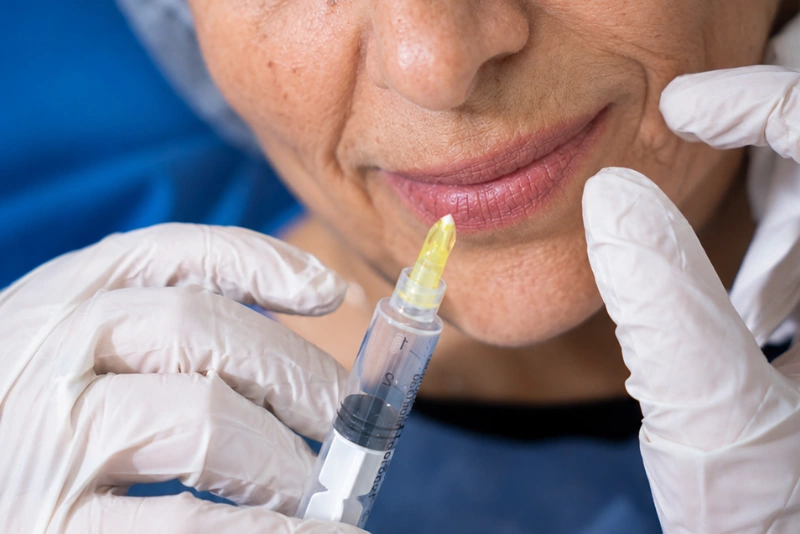
They can also be applied to the lips, which lose volume and definition over the years, to improve their shape and texture; and at a deeper level, to the subcutaneous fat that supports the facial contour, to address loss of volume under the cheekbones or to improve jawline definition.
The protocol: 2 to 3 applications
Clinical experience points to a protocol of 2 to 3 applications to begin seeing changes. The first is performed on the tissue as it is and aims to prepare the ground: the first changes —greater elasticity, hydration and firmness— are usually subtle. Between the third and fifth week afterward, a second application is performed, this time on tissue that is already in the process of regenerating, when improvements are usually more clearly noticeable. When appropriate, a third application —at the same interval— continues to enhance that process.
The timing and number of applications needed vary from case to case, and are defined with the medical team based on an individual evaluation.
How it differs from other techniques
Other options, such as platelet-rich plasma or hyaluronic acid, work differently: platelet-rich plasma stimulates local processes without restoring volume, and hyaluronic acid fills the space temporarily but is reabsorbed over time and usually requires repeat applications. Stem cell therapy proposes a different mechanism: it seeks to stimulate the biological regeneration of the tissue itself, with a protocol of applications spaced out over time.
Frequently asked questions
Where do the stem cells used come from?
From the patient’s own fat tissue. They are autologous cells, meaning they come from the same person who receives the treatment.
How many sessions are needed?
Clinical experience points to a protocol of 2 to 3 applications, spaced 3 to 5 weeks apart. The exact number is defined for each case.
Is it a risky treatment in areas such as around the eyes?
These are highly vascularized areas, where other treatments may pose a greater risk. The application of stem cells is planned so as not to compromise periocular vascularization, and the medical team assesses in each case whether it is appropriate.
Are the results permanent?
It varies from patient to patient and depends on multiple factors. The goal is to stimulate the regeneration of the patient’s own tissue, and its progress is followed case by case with the medical team.
Interested in this approach for your skin? A medical evaluation makes it possible to define whether autologous stem cell therapy is a suitable option for your case.
A biological process, not an immediate result
Stem cell regeneration is progressive: it builds over several weeks and applications, not as an instant effect. That is why the initial medical evaluation and following the protocol are a central part of the treatment.